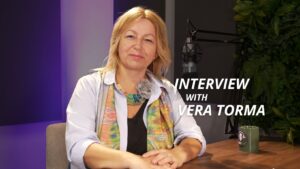

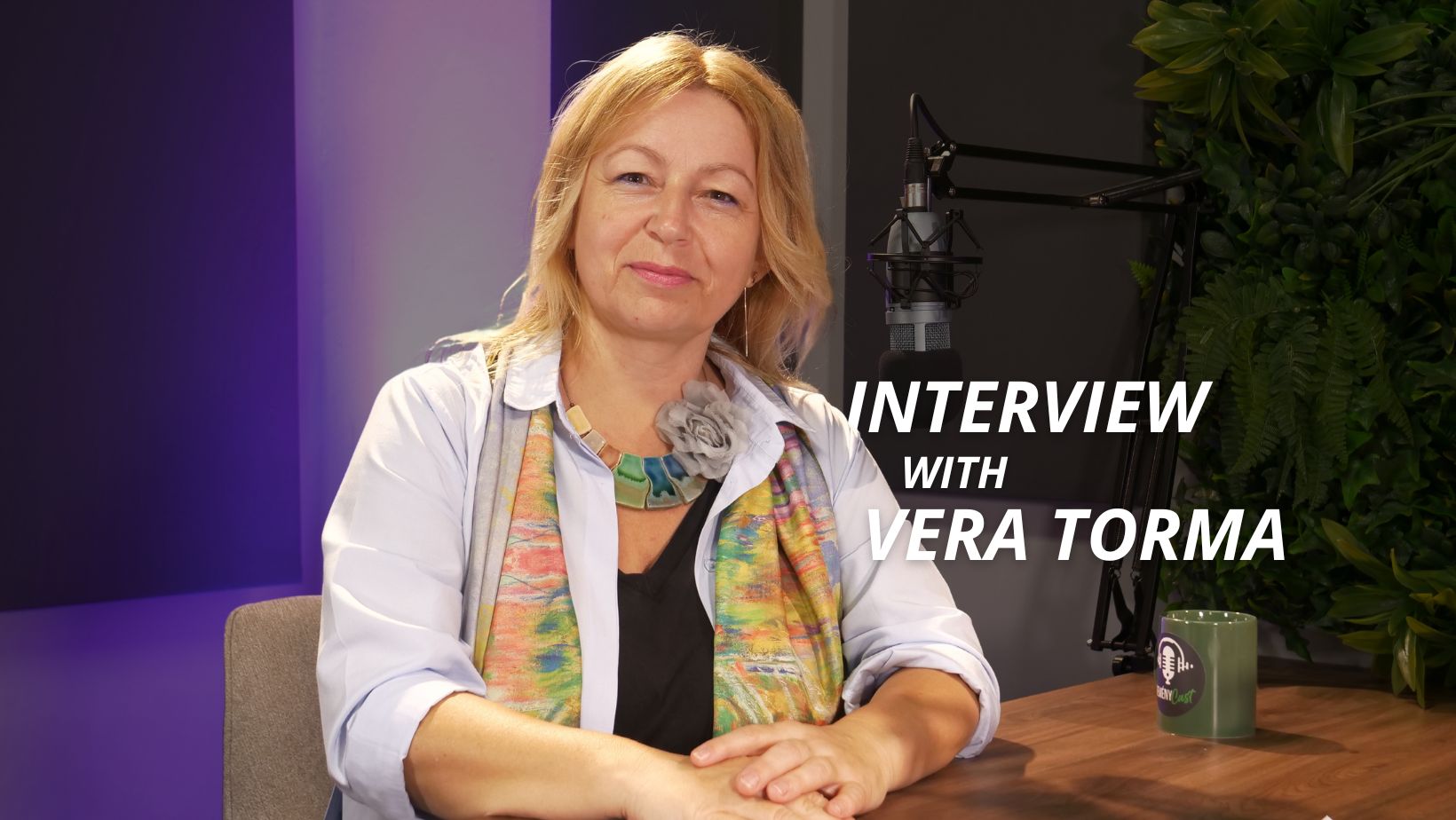
We may all go through periods in life when we feel alone and unable to go on—whether due to emotional crises or financial hardship. In this article, Vera Torma talks about how we can help ourselves, what sources of strength and solutions can give us hope, and where we can turn for help. Vera is from Sepsiszentgyörgy and is the head of the Diakonia Christian Foundation’s child and family support service. She also works as a coach, drawing on her own experiences to inspire others to overcome difficult situations.
Dear Vera, I warmly welcome you. I’m very happy to have you here again. It’s wonderful to see your cheerfulness and positive presence. That’s exactly what we’ll be talking about today. We’ve met several times before, and we also worked together on a project with HGMI. Where does that project stand now?
I warmly greet everyone as well, and thank you for the invitation. It’s a great honor to be here. HGMI is a great example for me. Our joint project bore many fruits: we trained around 60 teachers, and we’ve been receiving feedback ever since. They were very grateful for the guidance on how to work sensitively and with understanding with Roma children. They truly appreciated the training, and we can already see its impact.
The feedback was very positive, and teachers have been able to apply much of what they learned. You are now working in diaconal service. Could you tell us a bit about that? What kind of organization is it, and what is your role?
Diakonia is the charitable service of the Reformed Church in Transylvania. I have been working at the Sepsiszentgyörgy branch since 2011. We mainly organize programs for children, especially those from disadvantaged backgrounds, but we do not separate them from others—we lift them up together through love. The organization works in many areas, such as home care and support for people with disabilities. Our Child and Family Support Service currently accompanies more than a thousand children in Sepsiszentgyörgy and the surrounding area.
You also help many Roma children living in extreme poverty.
Yes. In every settlement there are many Roma children, and we support Romanian, Hungarian, and Roma children equally. But I must admit that Roma children are especially close to my heart. I have been consciously involved in Roma mission work since 2014, and whenever we begin work in a community, we do so with a long-term commitment. There are communities where we have been present for 10, 20, even 30 years—and that is what brings results.
How did this calling develop in your own life? You work as a helper with heart and soul, but this is a very demanding field.
In fact, when I was just 14 and preparing for confirmation, I already felt a desire to serve. At that time, I thought this was only possible as a pastor, so I applied to study theology three times, but I wasn’t accepted. That was very hard to accept, because I was convinced this was my path. Today I see that God called me to the same service, just in a different form. I still work with people—children, families, the elderly—and I carry out the same mission, just not in an official pastoral role. And often I find that when I share my testimony, it is powerful precisely because I speak from outside an official church position. There is a great need for that as well.
It is indeed very important to see situations from the outside. What are the biggest challenges you face in Roma communities?
In many settlements, Roma families live in extreme poverty. In many places they live in shacks, and often there truly is nothing to eat. This is the visible form of suffering. But we must also see that similar problems exist in wealthier families as well—they are just less visible. The root of the problems is often the same: when a person has no anchor, no sense of why they exist in this world, they are left alone with their fears and struggles. Whether rich or poor, Romanian, Hungarian, or Roma—without God, it is very hard to carry the burdens of life. That is why we don’t try to offer only material help, but also faith, hope, and community. We see that when someone finds God, they begin to handle their problems differently—and real change takes place.
But how do you convey all of this? How do you tell them that there is a solution?
It’s not simple. We know that “ask and it will be given to you,” but you can’t simply say that to people whose refrigerator is empty and who have no bread. That’s why we primarily reach out through the children: we provide food and opportunities to learn, because a hungry child cannot develop. And if a family has nothing to eat, talking about faith alone is not enough. First, basic needs must be met.
Once that is in place, we can offer spiritual support and hope. This is where we are now: physical assistance is functioning well, but sharing the Gospel requires even more coworkers. Many help us as teachers and social workers, but fewer are able to pass on faith as well. We experience that when children and families understand that they can turn to God, real transformation begins. But this requires time, perseverance, and many willing hearts.
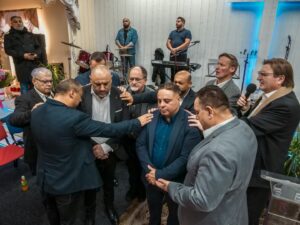
Who supports you, the helpers? You are now at the Carpathian Basin Roma Mission Conference, where missionaries, pastors, and helpers arrive from several countries. Is this truly helpful for you? Do you draw strength and guidance from it that you can later apply at home?
Yes, it is a tremendous help. I believe that when God starts something, He also provides people and support along the way. We first connected with Roma mission work through the Hungarian Reformed Church Aid, participated in trainings, and through that we also came to know the work of Albert Durkó and his colleagues.
It was very important for us to see that this work already functions here: there are results, converted lives, and strengthened communities. For us, this is not only encouragement but also confirmation—it can be done, and it is worth doing.
We are still learning this ministry. That is why we brought a group to the conference this time as well, so they can see with their own eyes that the Gospel truly changes lives in Roma communities. We often hear that “Roma people cannot be helped or integrated,” but here it can be shown: it is possible—and it is happening.
Roma communities often feel that no matter how much they try to prove themselves, they are not trusted. How do you see this?
Indeed, this is not the fault of individuals; society has pushed them to the margins. I have learned that it is not about integrating them, but about lifting them up to God. The essence of inclusion is that everyone is valuable together with their own culture—this is where real breakthrough happens.
And it is so important for them to believe that before God all people are equal, and that Roma culture has value.
Very important. Whenever I visit a Roma settlement, I always learn a great deal. Roma people do not dwell on their problems; they have humor, they can sing and dance, and their community life is incredibly strong. There are large families and close-knit communities—something our wider society could also learn from.
I also know that your own life has not been easy, and that you went through a very difficult period. Would you share that with us?
Yes. Much of my childhood and youth was very happy—I grew up in a loving family where I received everything and was supported in every way. Later, when I got married, I believed that marriage was “forever.” I believed that the partner God gives us stays with us until death. But life turned out differently. My husband was Dutch, and there were significant cultural and worldview differences between us, and eventually we had to divorce. This was a huge break in my life, because this was not how I had imagined it. I fell very deep, and it took time to stand up again. But today I understand that this, too, was part of becoming who I am now.
So the divorce was not your decision?
I experienced it as not being my decision. I would have stayed, because I imagined growing old together. But God gave me a different path. I had to step out of that situation, and it was incredibly painful. I was completely broken and argued with God for a long time, because I felt I had sincerely prayed for a happy, lasting marriage. But today I see that it had to happen this way, and through it I truly learned who I am and where my path lies.
How did you manage to overcome the difficulties of divorce, and what role did community and faith play in this?
At first it was very hard. I withdrew, struggled with God, and felt despair for a long time. But when I accepted that I needed to move forward—especially for my child—I began praying again, and God truly sent helping people into my life. I moved to a new city, was alone with my baby, and found myself in a difficult situation both financially and emotionally. At Diakonia, I was given the opportunity to organize children’s programs, which gave me a new community and a sense of purpose. Soon I met many supportive people who helped me in my work and in everyday life. This experience taught me that faith and a supportive community can provide strength even in the most difficult situations, and it set me on the path where today I can proudly share my story.
How did you experience the power of community in your work, and how did this lead you toward coaching?
I noticed that when people are given space, many are eager to connect with good causes. There was a time when our children’s program needed a large amount of funding, and the local business community—whom we often think of as distant and distrustful—stood by us in the hundreds. I experienced that when we make our work visible, even through social media, people are willing to help; we just need to create the opportunity.
At the same time, I felt that as our work grew, I also needed to grow. I first studied pedagogy, then human resources, because I had to lead an increasingly large team. Still, something was missing: how could I remain spiritually balanced and present, authentic and strong? That’s when I encountered coach training. I immediately felt that this was what I needed—to work on myself more consciously while helping others even more effectively. For me, it became a natural continuation of the path I had started in charitable service.
What does being a coach mean, and how does this appear in practice in your work?
The word “coach” originally means “trainer”—someone who stands beside you, encourages you, and helps bring out the best in you. It also helped me in my leadership and organizational work, especially when I could no longer personally know every colleague and had to build systems. Coaching taught me how to support people through questions so they can bring out the best in themselves from their own inner motivation. I don’t work as a psychologist or mentor; I help active, goal-oriented people move from point A to point B more quickly and consciously. It also helps me “set myself straight” every morning and makes my leadership work more effective, because everyone works in the role they are best at and truly enjoy.
You actively coach and also share your thoughts publicly. How do you handle feedback?
Yes, I actively use coaching with myself and my colleagues, and I share my morning reflections with hundreds of people. Many respond that it helps them, so I feel it’s worth sharing. As for negative feedback, I handle it simply: I live boldly according to my principles, with God’s help—and those who don’t agree are free to move on.
How does your daughter see you?
It’s a great joy to see that my 15-year-old daughter now supports me. She watches what I do, learns from my example, and is happy that I am cheerful, involved in the community, that we go on trips and enjoy life. Sometimes she teases me, but that’s also part of how we’ve grown and learned together.
Did your daughter give you strength during difficult times?
Yes, my daughter Sacika gave me the greatest strength. Every morning I got up to be a good example for her and to grow, so that I could support the greatest gift of life—my child. This motivated me to learn from past mistakes so that she could live a happy, balanced life with God’s help.
Which is closer to your heart today: diaconal service or coaching?
For me, diaconal service is a calling, not a job. Serving among children and families is part of my life, and whenever I might have stepped away from this path, God led me back. About every seven years there has been a renewal in my life so that I wouldn’t stagnate—and coaching became such a new gift. It helps me serve with renewed strength, to put myself in order, and to gain new momentum. Coaching didn’t replace diaconal work; it came alongside it. It adds color to my life and also replenishes me.
Was there a time when you felt exhausted and unable to go on?
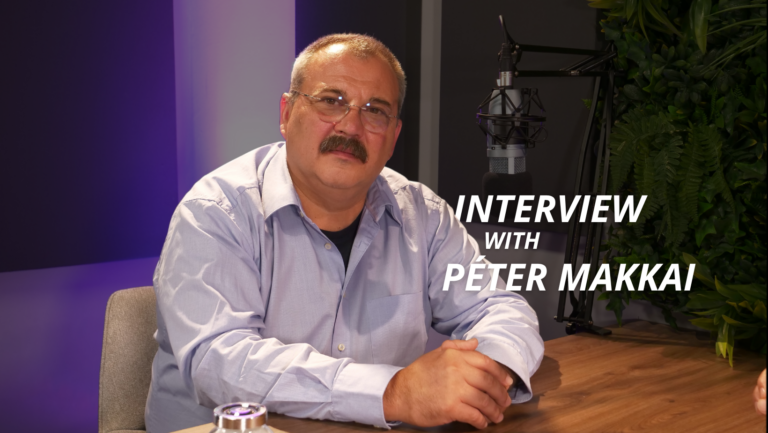
Yes. There was a moment when I told our director, Péter Makai, that I was afraid of burning out because I always work with intense passion. He simply replied, “Vera, it matters where you draw your strength from.” That hit home. I realized that if I don’t rely only on myself, but ask God to help, guide, and show the next step, I always receive new strength. When everything seems humanly impossible, grace arrives—and things are resolved. And I stand there in awe, saying, “Forgive me, Lord, I underestimated You again.”
What is your hope?
For me, hope means hoping for good, because one cannot truly hope for evil. I believe that God always wants what is best for us, and that even difficulties teach us to value life. This faith gives strength, peace, and joy, and allows us to live gratefully and happily, knowing that everything can be turned toward good.
Some people say, “This can’t be true; it doesn’t work.” What do you say to them?
I usually say: try it. I am neither better nor more than anyone else. I simply live in conscious relationship with God. I talk to Him, ask, entrust myself to Him, and accept it if things turn out differently. That doesn’t mean I have no difficulties—negative thoughts, fatigue, and disappointment still come. But then I consciously restore order within myself, because it’s not what comes from outside that contaminates us, but what comes from within. If I am present with good thoughts, gratitude, and hope, that is reflected back in my life. And anyone can experience this—if they begin to practice it.
Who can you turn to when you are in a difficult situation? Who are the people closest to your heart?
I am very grateful because I am surrounded by many supportive people. I speak with my mother every day, and my sibling is also a great support. I have friends, colleagues, and an excellent leader with whom I can speak honestly. There are many people around me from whom I can ask advice—whether a businessperson, a pastor, or an old friend. My experience is that when we dare to ask for help, people are there and willing to help. God sends many “angels” alongside us—we just have to notice them.
How did you get from the deepest pit to where you are now?
At the time, I felt that I had lost everything: after the divorce I was broken financially, emotionally, and as a woman. I started over in a new city, in a new community, without work, money, or acquaintances. From there I arrived here through God’s grace and the help of the blessings and supportive people around me. It mattered greatly what kind of family and community I came from, and what kind of teachers shaped me—this gave me strength. I learned to notice the good things around me, to give thanks for them, and in this way rebuild my life and give back to others what I had received.
Do you have a final message you would like to share with viewers?
Recently I dreamed that God spoke to me and said that although we cannot see His face, His grace and blessings are all around us. The message for me is that we should live as joyful children of God: live, love, rejoice in life, and pray when we have reason to be sad. When we rejoice, God rejoices with us, and in this way we can bring blessing to the world.